A follow-up to Why we're building better roads, not selling faster cars.
In July I argued that AI hands everyone a faster car while almost no one is building better roads. The cars are the models, and a faster one ships every few months. The roads are what turn that horsepower into work worth doing: the shared space, the shared context, and the human thinking that frames the problem and checks the answer. This fall, two of the biggest carmakers made a change that shows why the road matters.
OpenAI is retiring custom GPTs in favor of plugins, and they are scheduled to stop running on December 11, 2026. Google is replacing Gems with Skills, ending support in November for personal accounts, March 2027 for business and enterprise customers, and June 2027 for education.
If you have never built one, a custom GPT or Gem is a version of the chatbot you set up once and reuse. You name it, tell it how to behave, and hand it what it should know: your syllabus, your rubric, your underwriting guidelines, your team's playbook. Then you stop re-explaining yourself every time you open a new chat.
Almost nobody who built one calls it a chatbot. They call it a tutor, an advisor, an intake assistant, a reviewer. The container was generic, but the thinking poured into it was not, and that thinking now sits on someone else's product roadmap.
So we are launching Save the Bots. For readers new to us, BoodleBox is an AI platform used by more than 160 colleges and universities and 130 companies. It does two things the big AI apps don't: it puts the leading models, including GPT, Claude, and Gemini, in one place, and it lets several people and several bots work in the same conversation at once.
First, though, I want to be fair to OpenAI and Google. For them, retiring custom bots is the right call.
ChatGPT, Gemini, and Claude are each built around one company's models and, mostly, around one person at a time. All three let you share files and instructions with teammates or send someone a link to a conversation. None puts several people in one live conversation.1
In that world, a custom GPT or Gem was never really a separate bot. It was the same engine with a different set of instructions taped to the dashboard. As the main assistant gets smarter, a separate bot becomes friction: open a side panel, pick a bot, start over. Plugins and Skills remove that step by letting the assistant pull in the right instructions mid-conversation. Google's Skills sit a shortcut away, and OpenAI's plugins bundle instructions, reference files, and connected apps.
If I were building an assistant for one person on one company's models, I would make the same call. When there is only one car, you don't need a garage of copies in different paint. You need one car with better accessories.
BoodleBox was built for many people and many models, so the logic runs the other way. On a road system, bots are travelers, not accessories.
On BoodleBox, a bot isn't tied to the model it was built on. The same instructions and knowledge run on GPT, Claude, Gemini, and whatever ships next. When a better model arrives, you switch the model and keep the bot. The expert captures what they know once, rather than every time the frontier moves. A new model still gets a test run on familiar tasks, because it will read the same instructions its own way.
Model independence also allows something no single-vendor product can offer: running the same bot on two models side by side. Every model has its own blind spots, and when two disagree, you know where to look. Check the source, or ask someone who knows. The best model changes every few months. The expertise you encode shouldn't have to.
In the manifesto I described the AI Curve from West Point's EECS Department. AI makes generating output fast and nearly free, and the hard human work moves to the two ends: defining the right problem and validating the answer. A custom bot is how an expert encodes their expertise so others can draw on it at both ends.
When trial lawyer Mark Lanier poured 42 years of case judgment into a shared workspace until it reasoned in his voice, he was building a custom bot. So is a nursing professor's Socratic tutor, or a proposal coach that carries what a firm learned from the last fifty bids it lost.
A bot also carries its builder's guardrails. An instructor decides what the tutor will and won't do: offer hints instead of answers, draw on the course readings, stay inside the assignment. Those boundaries are expertise too, and they should travel with the bot instead of being rebuilt each time a vendor changes formats.
A shared folder is not a shared room. In a BoodleBox GroupChat, people and bots work in the same thread, and a bot can be assigned to a class, a department, a practice group, or an entire organization. Everyone sees which bot said what, and who built it.
Picture four students working a case with their instructor's case-analysis tutor. The instructor drops into the thread, sees where they got stuck, and adjusts the tutor before the next section meets. A skill one person calls up privately can't do that.
This is also where the migrations hurt most. According to OpenAI's migration FAQ, a migrated GPT loses its sharing settings, and its existing users don't get access to the replacement. A personal plugin starts private, and making it public takes a separate submission. The original becomes read-only, custom actions don't transfer, the model you chose doesn't carry over, and old conversations stay behind.
So the tutor two hundred students opened from a link in the syllabus becomes, on migration day, a tool only its builder can reach. It stays that way until the builder sets up sharing again and every student switches over.
Google's path is smoother, but not seamless. Gems migrate into Skills automatically, yet Skills don't yet support Canvas, Deep Research, or Guided Learning, and sharing is promised rather than available. For educators, the bigger change is where Gems live. At the education transition they are removed from Google Classroom and from learning management systems connected through Gemini LTI, and Gems built in Workspace have to be recreated by hand.
The questions I hear from faculty and team leads this fall are practical ones. How do I explain this to students mid-semester? What happens to the links in the syllabus and the team wiki? Who has to redo the work?
BoodleBox will not retire custom bots. We will keep making them better, and if a better way to package expertise comes along, it will arrive beside your bots rather than in place of them.
Gems arrived in August 2024 and are being converted barely two years later. I don't fault Google or OpenAI for that. It is what happens when you build on a road someone else owns: it gets repaved, rerouted, or closed on the owner's schedule, not yours.
None of this makes plugins, skills, or MCPs a mistake. They are useful, and BoodleBox already has Skills, with plugins and MCPs on the way. What we won't do is trade a bot's identity for capability, a trade that only makes sense when one person is in the room.
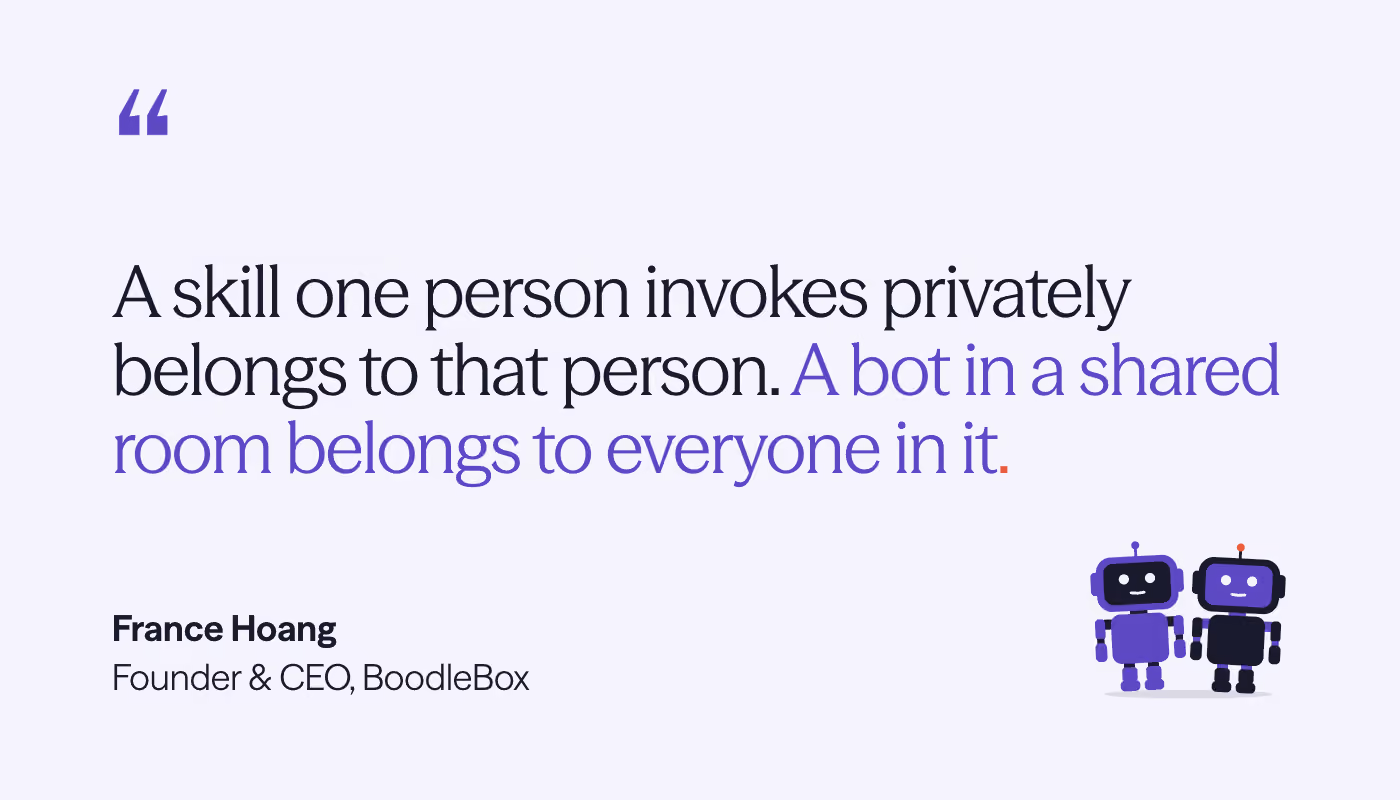
A skill is something an AI can do. A bot is a named thing a group can share.
A room of one needs only the first. A room of many needs both.
A fair critique of AI literacy is going around: it collapses into product training, and product training expires with the product. December 11 will put that to the test.
But the people who built custom GPTs learned more than a feature. A good bot forces you to define the problem, write instructions precise enough to follow, choose the evidence it should rely on, and then test and constrain it when it goes wrong. That is discernment in practice, and it carries over to whatever tool comes next.
Charlena Miller, an assistant professor of management at Doane University, has her students build bots first, then Skills, then agentic workflows for real work problems. They don't reach the last step without the first. Building and constraining a bot is how they learn to drive AI responsibly.
The risk is teaching the buttons instead, because a single-vendor product teaches its own habits. Having many models in one room makes the better lesson easier to teach. When students put the same question to three models and watch them disagree, they learn that the answer needed checking. Then they do the checking: tracing sources, explaining their criteria, defending a conclusion, and knowing when to bring in someone with more expertise. Do that often enough and you have taught discernment, the part that survives every deprecation notice.
Found a stranded bot? Stay calm and step away from the delete button. The full rescue plan is at boodlebox.ai/savethebots.

Susan Purrington, a Generative AI Teaching and Learning Fellow at Connecticut College, made this move in February 2025. She had built RT SimuCare Connect, a recreational therapy simulation, in PartyRock, and followed these same steps to bring it to BoodleBox so students, interns, and practitioners could all use it. Saving that bot, she told us, “was why I switched to BoodleBox.”
Have bots that need rescuing? Tell us how many and where they live, and our team will help you move them, whether it's one assistant, a department's shelf, or a campus library.
Coming next: A private road is not a road system. The frontier labs are racing to build shared team workspaces of their own. That is good news, because it means the market agrees that shared context matters. But a well-paved private road still admits one brand of vehicle, and for high-stakes work, a second opinion from the same AI isn't a second opinion. More on that soon.
Let's build a road that lasts.
France Hoang, Founder & CEO, BoodleBox
P.S. If you believe AI should make us more capable together, not just faster alone, sign the Better Roads Manifesto.
Move your custom GPT or Gem to BoodleBox. It's free to start, and it runs on every model.
Save your botFrance Hoang is the Founder and CEO of BoodleBox, a Collaborative AI platform selected by more than 150 colleges and universities and 130 companies to bridge the gap between education and the workforce. Evacuated by the U.S. Military from Vietnam in 1975, France's journey — from refugee to West Point graduate to White House staffer — reflects the conviction at the heart of BoodleBox: that education, service, and collaboration unlock human potential at every level.
With over 25 years of experience spanning national security, law, technology, and entrepreneurship, France has served as Associate White House Counsel and Special Assistant to the President, deployed as the Executive Officer of a U.S. Army Special Forces Company in Afghanistan, and been on the founding teams of companies generating over $600 million in combined sales. BoodleBox now serves more than 120,000 users and is backed by a partnership with Microsoft Elevate.
France's work centers on AI readiness: equipping students and professionals with the skills to collaborate effectively with AI while sharpening the critical thinking, creativity, and ethical judgment that define human excellence. A frequent speaker on AI literacy and the future of learning and work, France is based in Colorado.
Learn more about the ins and outs of the BoodleBox workspace from our team of experts.
Schedule a meetingLooking for more information?