We are sharing this beyond our team because the argument matters beyond our walls.
Internal memorandum
TO: The BoodleBox Team
FROM: France Hoang, Founder & CEO
DATE: June 23, 2026
RE: Why we're building better roads, not selling faster cars
Team, we closed our $5M Seed Expansion Round. Here is why it matters to me, and why the work in front of us is bigger than any single tool.
Here is the whole argument in one line: AI hands everyone a faster car; almost no one is building better roads. The most valuable human work has moved to the two ends of every task (framing the right problem and validating the answer), and those are precisely the skills our institutions practice least. BoodleBox exists to build better roads: the shared space, the shared context, and the human thinking that turn raw AI horsepower into work that arrives somewhere worth going.
I came to this country as a refugee: first a plane, then a tent, and somehow the American Dream. Every door that opened, education opened: West Point, the White House, a combat tour in Afghanistan, a university trusteeship, and a few companies founded along the way. Three convictions drove me through every door: a desire to serve, a love of education, and the belief that people are at their best together. Those three became the core values of this company.
I assembled a team to build BoodleBox because I was worried, and I remain worried. The most powerful technology in human history is being deployed in a way that isolates people, rewards the already-privileged, and conflates producing an answer with solving a problem. As Steve Wozniak suggested, there is not enough Actual Intelligence in Artificial Intelligence. Here is the whole case: what is broken, what we are building, and why it cannot wait.
Let's start with a distinction the rest of this argument depends on. There is a difference between doing work (producing output) and getting work done (solving the right problem well). AI has made doing work almost free. It has made getting work done harder.
For most of history, the hard part of any task was the middle: generating the solution was the hill you had to climb, and schools and companies built themselves around training people for it. AI flattens that hill. Generation is what AI does best, fast and nearly free, so the climb becomes a drop, and you coast to a finished-looking draft in seconds. The ease reads as arrival (there is output, so surely the work is done), but you have only reached the floor of the GenAI pit, where easy, plausible output pools and looks complete, a comfortable place to be stranded.
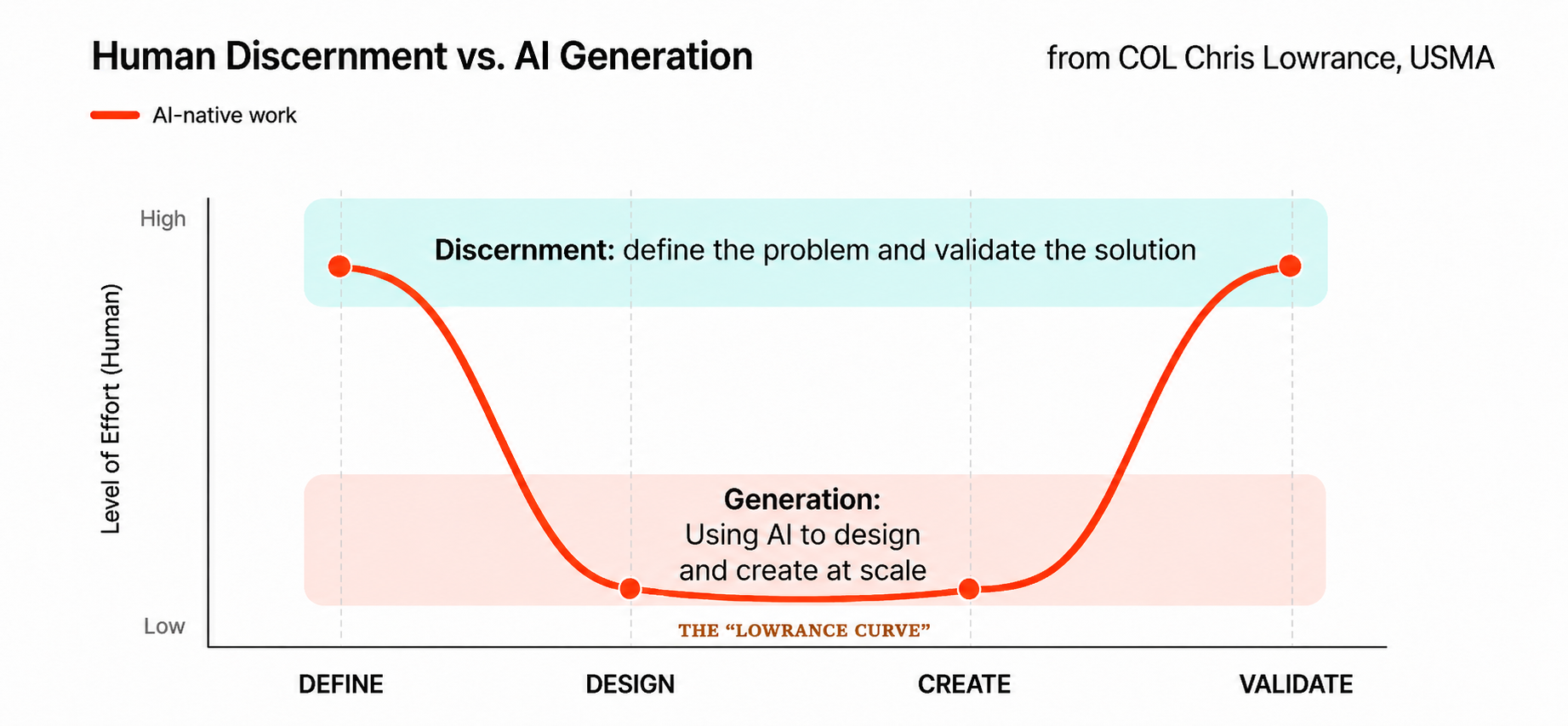
That is the whole trap: generation is so cheap that you skip the framing on the way in and mistake the floor for the finish, falling past Define, then camping where you landed instead of climbing out to Validate. The work did not vanish; it moved to the two rims, framing the problem before you fall in and validating the answer to climb back out. That is the inversion1: effort leaving the middle for the two ends, the most important and least practiced parts of the work2.

This shape has a name: the Lowrance Curve, after Colonel Chris Lowrance, the West Point professor who first framed the inversion this way. Trace it left to right: Define stands high on the near rim, the middle sinks toward the floor as AI makes that work all but free, and Validate rises again on the far rim — a valley where a hill used to be. The middle, Design and Create, is generation, what AI does at scale. The ends, Define and Validate, are discernment: framing the problem, then interrogating the answer, asking not just whether it passes but what it assumed and what it missed3. The discipline is easy to name and hard to keep: frame before you fall, and validate before you call it done.
When generation is cheap, the bottleneck moves. It is no longer making things; it is deciding what is worth making and whether it holds up. The failure already has a name: workslop, AI output polished enough to pass as finished4 but hollow enough that whoever receives it has to redo the work5. The pattern shows up at scale: a 2024 RAND analysis found that more than 80% of AI projects fail, roughly twice the rate of IT projects that do not involve AI, and traced the leading cause not to weak models but to organizations misframing the problem they set out to solve6.
This is the heart of it. Artificial Intelligence (generation at speed and scale) does not replace Actual Intelligence, the human discernment that frames the problem and validates the answer. Put the two together and you get what neither produces alone — Collaborative Intelligence: human discernment amplified by generation at scale. Discernment is not a step you add at the end. It is the work.
Careers used to follow an arc. You began as a generator: a student building proficiency, then a junior turning problems other people defined into solutions and learning judgment from the feedback. Over years you earned the right to discern: to define the problems and validate the work. Generation was the first rung. Discernment was the top of the ladder.
AI now does the generating, the very rung careers used to start on. That raises a question most institutions are dodging. The easy version is how do we develop people when the entry-level work is automated. The honest version is harder: why develop them at all, if the machine can generate7?

The answer is that generation was never the point; it was how you learned to discern. So here is what we are for: from day one, everyone needs what used to require a promotion: the discernment to define the problem, interrogate the output, and validate the result. Hold that against the two responses most institutions reach for, and both fall short:
Both fail for the same reason: each still casts the next generation as generators, the one role AI has largely taken. The work has inverted; how we develop people has to invert with it.
Teaching that is what education was always for. In the spirit of a line often attributed to Plutarch, the mind is not a vessel to be filled but a fire to be lit. That fire is what we call AI Readiness:
We call it AI Readiness, but every capacity in that triad is human. It is really human readiness; the technology is simply what finally made these skills non-negotiable.
This is the answer to the harder question. The apprenticeship used to be about generation: you produced for years, and the doing of it slowly taught you to discern. Now it has to build both from the start, which means it demands discernment far sooner than before. AI cuts both ways: it changes what climbing the ladder takes and adds new ways up. Building that capacity deliberately, instead of leaving it to accrue over years, requires AI Readiness.
Higher education is where this is anchored: colleges and universities are society's central institutions for developing thinking at scale, and they are BoodleBox's foundation, even as we serve organizations beyond the campus.
But a shift toward discernment carries a risk: it can favor those who already think like experts, widening the very divide we mean to close. Three things help counter that: putting AI within everyone's reach, making expert reasoning visible so novices can learn it, and using AI to build discernment rather than replace it. Done right, the readiness that lifts one person lifts a whole community.
But developing people is only half of it. Discernment is built, not bought10.
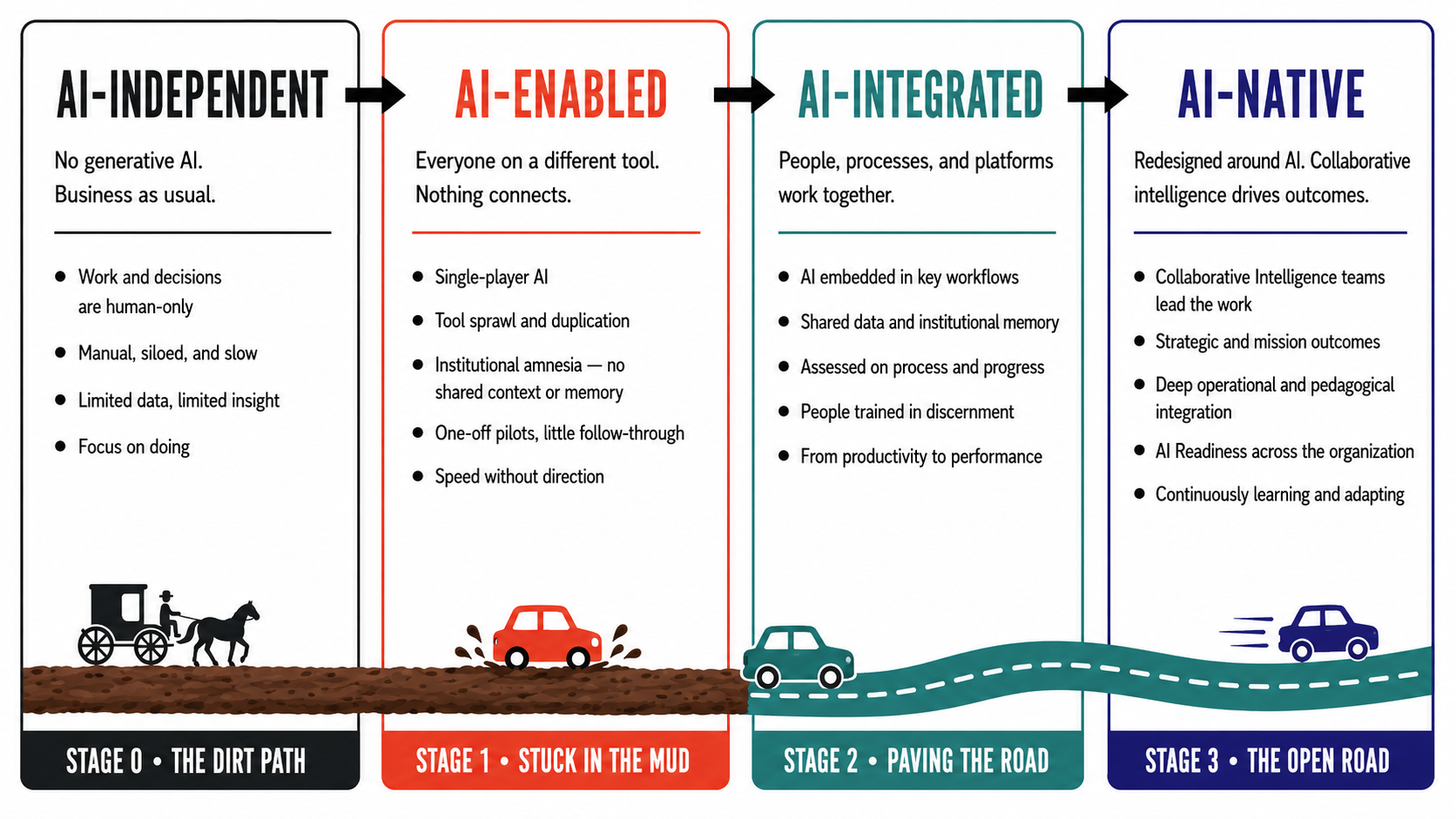
Faced with all this, most leaders reach for the oldest instinct there is: when the journey feels too slow, ask for a faster horse. AI looks like the answer: hand everyone a powerful tool, change nothing else, expect to arrive sooner.

But here the old instinct breaks, and a better metaphor takes over. AI is not a faster horse; it is a car, a genuinely new kind of machine that can reach places no horse, however fast, could ever go. But a car is only as good as the road beneath it: put a sports car on a rutted 1900s cow path and it is not faster. At best it rattles to the same place; at worst it sinks in the mud. And modern driving took more than a powerful engine: it took paved roads, trained drivers, rules of the road, and cars built to be safe at speed. Get all of that right, and the car does what no horse ever could. It takes you somewhere new.
The real work was never buying the fastest car. It is deciding where you are going and building the way there. Most "AI transformation" skips straight to the car: fast machines on old roads. One university system handed AI to half a million students with no training and got panicked faculty returning to blue books and frustrated students in return. Well-meaning companies buy a thousand chatbot seats, touch no workflow, and wonder why they are still stuck in the mud.
Transformation takes road-building, not just access. That means investing in people, rethinking workflows, and developing thinking instead of rewarding raw speed. The question to stop asking is "how do we go faster?" The question to start asking is "where do we actually need to go?"
None of this means waiting for the highway. The first roads were merely good enough for the first cars; you drive, learn where the road lacks, and build better (dirt to gravel to pavement), upgrading the road as the car improves, instead of standing still or flooring it on a dirt track.
The vast majority of AI tools on the market (chatbots, copilots, coworkers, agentic coders) are single-player: one person, one AI, racing to an output. That is Artificial Intelligence at work. It is useful, but it is not enough. Collaboration does three things solo work cannot match. It accelerates thinking, sharpening it in the friction between people, between perspectives, and increasingly between AI models. It distributes thinking, so discernment is not trapped in a single expert's head. And it lets an institution retain that thinking, holding onto what it learns instead of letting it slip away. That is the case for a multiplayer, multi-AI environment: thinking happens faster, spreads wider, and lasts longer with it.
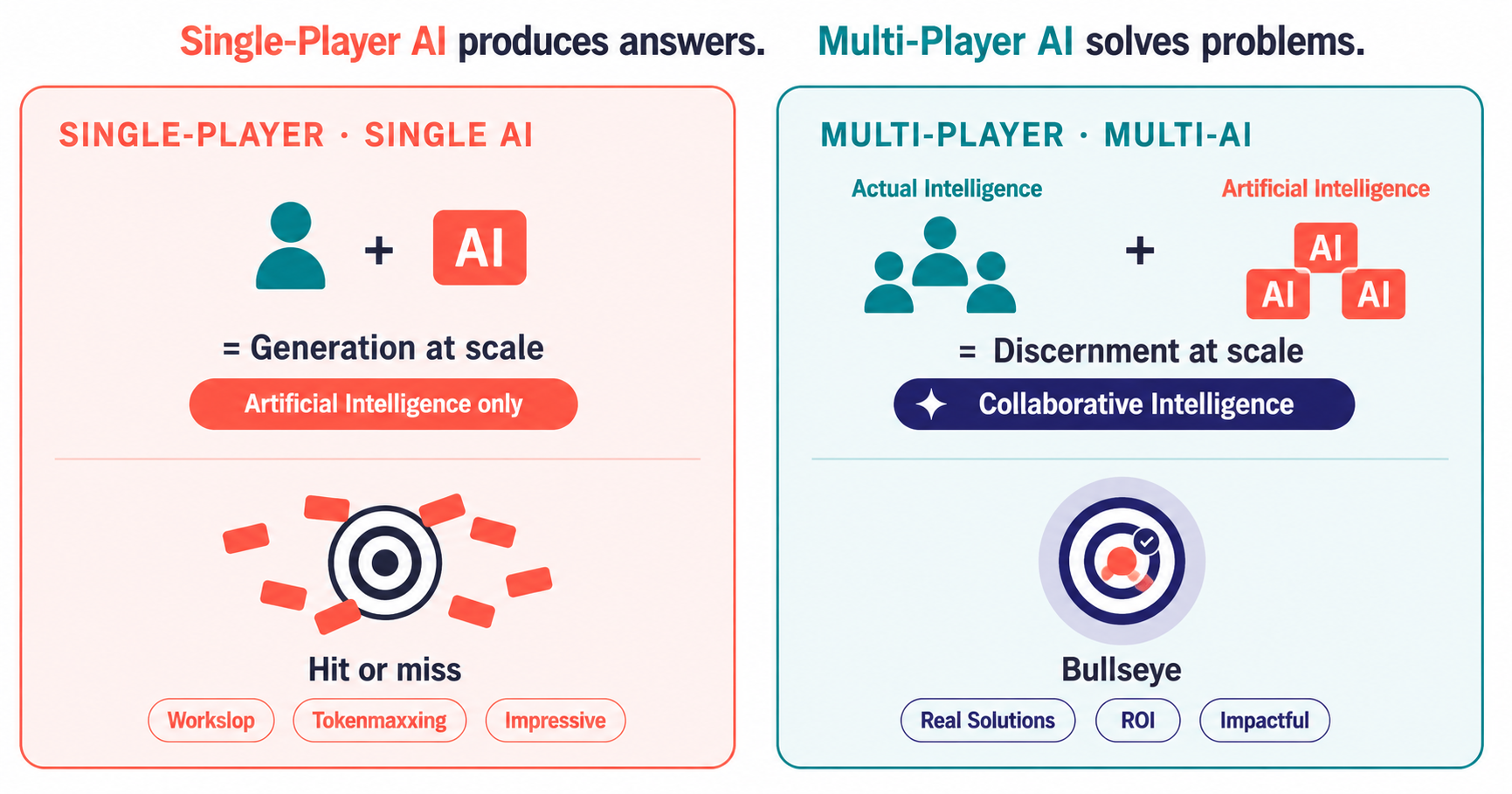
Single-player tools remove the very friction that builds thinking11, breeding dependency, silos, and institutional amnesia, where what a team learns evaporates at the end of every session12. The discipline that matters is selective offloading: hand the generation to AI, and deliberately keep the discernment at the center of human work. Single-player tools erase that line, offloading discernment along with labor. What this moment calls for is not a faster chatbot or a smarter agent, but the infrastructure that makes one worth using.
That is the infrastructure the argument has been driving toward, and it is what we are building. We call it a Collaborative Harness for AI: the layer where Actual Intelligence meets Artificial Intelligence. Its three pillars are not add-ons; each is what makes collaboration accelerate, distribute, and retain thinking in practice:
In practice, this is already proving out where the stakes are highest. Trial lawyer Mark Lanier and a team of fifty worked in one shared, multi-model workspace, not one lawyer and a chatbot14. They poured his 42 years of case judgment into it until it reasoned in his voice, then ran each day's transcripts through several models overnight to surface the weak spots. The AI drafted and pressure-tested; the team decided what held up. Of the hundred cross-examination questions it produced, he used six or seven. It was, in his words, "a tool, not a replacement." Meta and Google had AI of their own. They generated. He collaborated. His clients won a $6 million verdict in the first social-media-addiction case to reach a jury15.
When collaboration, shared context, and agentic assistance come together, an organization crosses from AI-Enabled to AI-Native, no longer burning tokens on Artificial Intelligence alone, but investing in Collaborative Intelligence. Working together becomes the path of least resistance. Workslop recedes. Institutional amnesia fades. No one need stay stuck at the bottom of the pit, because the climb out, framing and validating, is shared. People stop operating the tools and start leading the work that is theirs alone.
Everything we build flows from the three convictions I carried through every door:
And four non-negotiables we will not trade away:
The $5M lets us build the road: the shared space where teams do the human part of the work together, from classrooms to companies.
As John Adams wrote to Abigail in February 1776, with the Revolution far from won: "We cannot ensure success, but we can deserve it." (He was borrowing the line from Addison's Cato, a favorite of the founders.) We do not command the outcome, but we can deserve it, through the rigor of what we build, the integrity of how we build it, and the clarity of why it matters. We deserve it by closing the AI Divide instead of widening it, by building better roads instead of selling faster cars, by protecting the struggle instead of shortcutting it, and by choosing unbounded Collaborative Intelligence over limited Artificial Intelligence.
These convictions held true when I arrived in this country with nothing. They hold true for anyone, anywhere, willing to build something that deserves to last: serve, educate, and collaborate, not merely generate. Work hard, together, because that is where the best work has always happened.
Let us build a road that takes us — all of us — somewhere worth going.
— France Hoang, Founder & CEO, BoodleBox
If you share in this belief, show your support by signing and sharing our Better Roads AI Manifesto and add your voice to the growing group of educators, students, leaders, and professionals saying AI should make us more capable together, not just faster alone.
Sign the Boodlefesto
France Hoang is the Founder and CEO of BoodleBox, a Collaborative AI platform selected by more than 150 colleges and universities and 130 companies to bridge the gap between education and the workforce. Evacuated by the U.S. Military from Vietnam in 1975, France's journey — from refugee to West Point graduate to White House staffer — reflects the conviction at the heart of BoodleBox: that education, service, and collaboration unlock human potential at every level.
With over 25 years of experience spanning national security, law, technology, and entrepreneurship, France has served as Associate White House Counsel and Special Assistant to the President, deployed as the Executive Officer of a U.S. Army Special Forces Company in Afghanistan, and been on the founding teams of companies generating over $600 million in combined sales. BoodleBox now serves more than 120,000 users and is backed by a partnership with Microsoft Elevate.
France's work centers on AI readiness: equipping students and professionals with the skills to collaborate effectively with AI while sharpening the critical thinking, creativity, and ethical judgment that define human excellence. A frequent speaker on AI literacy and the future of learning and work, France is based in Colorado.
Learn more about the ins and outs of the BoodleBox workspace from our team of experts.
Schedule a meetingLooking for more information?