A follow-up to Why we're building better roads, not selling faster cars.
When I wrote that we were building better roads, not selling faster cars, the obvious next question was what does the road actually look like?
Here is the answer. The road is a shared space for multiple people and multiple AIs with persistent, shared context. It is a new kind of AI harness, a collaborative one, and ours is called a Collaborative Box. And the reason it matters is that almost every AI tool on the market today is still a car built for exactly one driver.
One person, one AI, one window — and whatever context you can cram into it before it gets unwieldy or you close the tab and lose it for good. Ask, answer, move on. It is fast. It is frictionless. It is built for an audience of one.
Work has never been an audience of one. Work is messy and distributed, full of handoffs and half-finished threads and knowledge that lives in someone's head right up until they leave and then doesn't live anywhere. I called this institutional amnesia in the manifesto: what a team learns evaporating at the end of every session. I want to be more precise about it now, because I have watched it for two years and I think we have been misdiagnosing it.
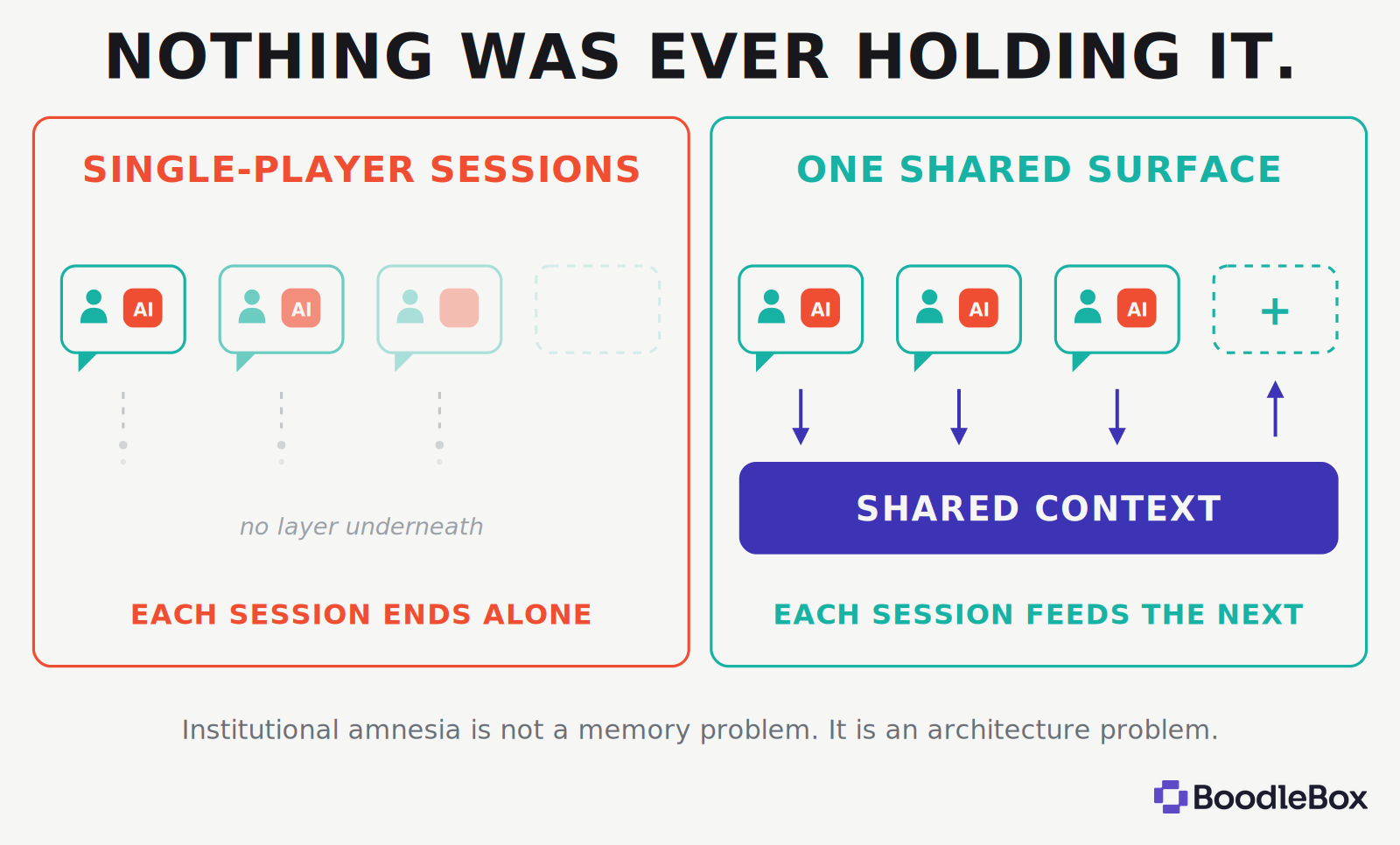
Institutional amnesia is not a memory problem. It is an architecture problem. Nothing is forgetting. Nothing was ever holding it in the first place.1
Here is the next argument in one line: we handed everyone a car and never built anything for them to drive on together.
The manifesto made the case that AI is a car, not a faster horse, and that a car is only as good as the road beneath it. The problem is not only that the road is rough. It is that there is no road system at all. What we have instead is millions of private lanes, each one paved by a single person, running from their door to wherever they were going, connecting to nothing.
That is what a single-player AI tool gives you. A private lane. It gets one person where they are going, often brilliantly, and then it ends. The output arrives somewhere — a doc, a thread, someone's downloads folder — but the thinking that produced it stays on the strip of pavement where it was made. The next person paves their own lane from scratch: re-explaining the same background to their own model2, arriving at roughly the same place by a slightly different route, learning nothing from the trip anyone else just took.
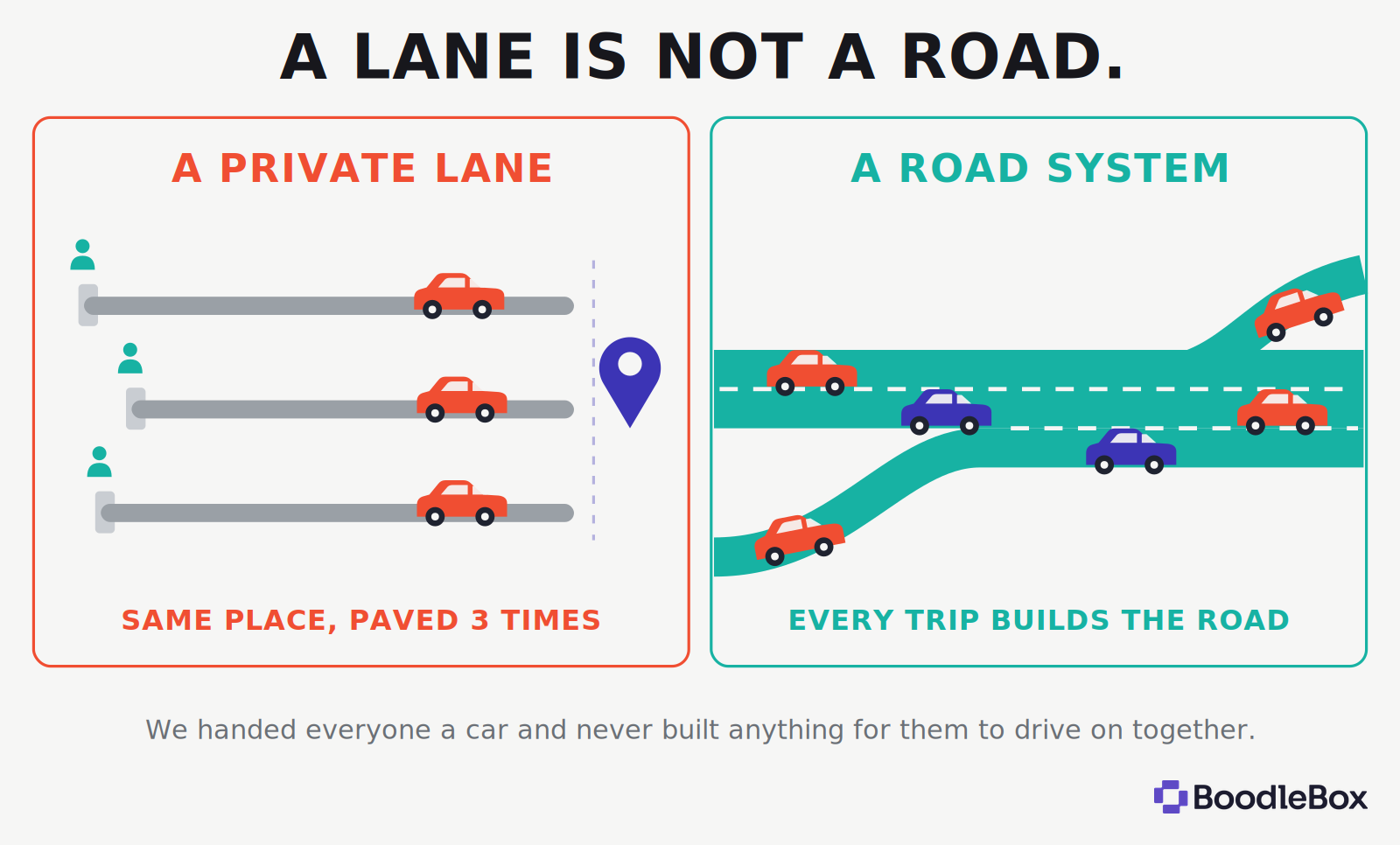
A road system is different in one specific way. It connects. Lanes that merge, intersections, signs, right of way — rules everyone agrees to before anyone moves. That shared layer is not a nicety. It is the entire reason a road network is worth more than the sum of the paths it replaced.
For AI, that shared layer is context. Which means shared context cannot be a feature you bolt on later. It has to be the surface the whole system rides on.
Look at where the industry is spending all its energy right now: vibe coding, autonomous agents running multi-step loops, and frontier models generating breathtaking drafts and artifacts in seconds.
It is undeniably impressive. But we have to be clear-eyed about what is actually happening.
There is a fundamental difference between doing work (producing output) and getting work done (solving a real problem well). Vibe coding an entire application in an afternoon or turning an agent loose to generate a forty-page research dossier is doing work at superhuman speed. But if nobody actually needed that app, or if the agent's dossier is built on unvetted assumptions that send your strategy off a cliff, you haven't gotten work done. You've just generated workslop faster.3
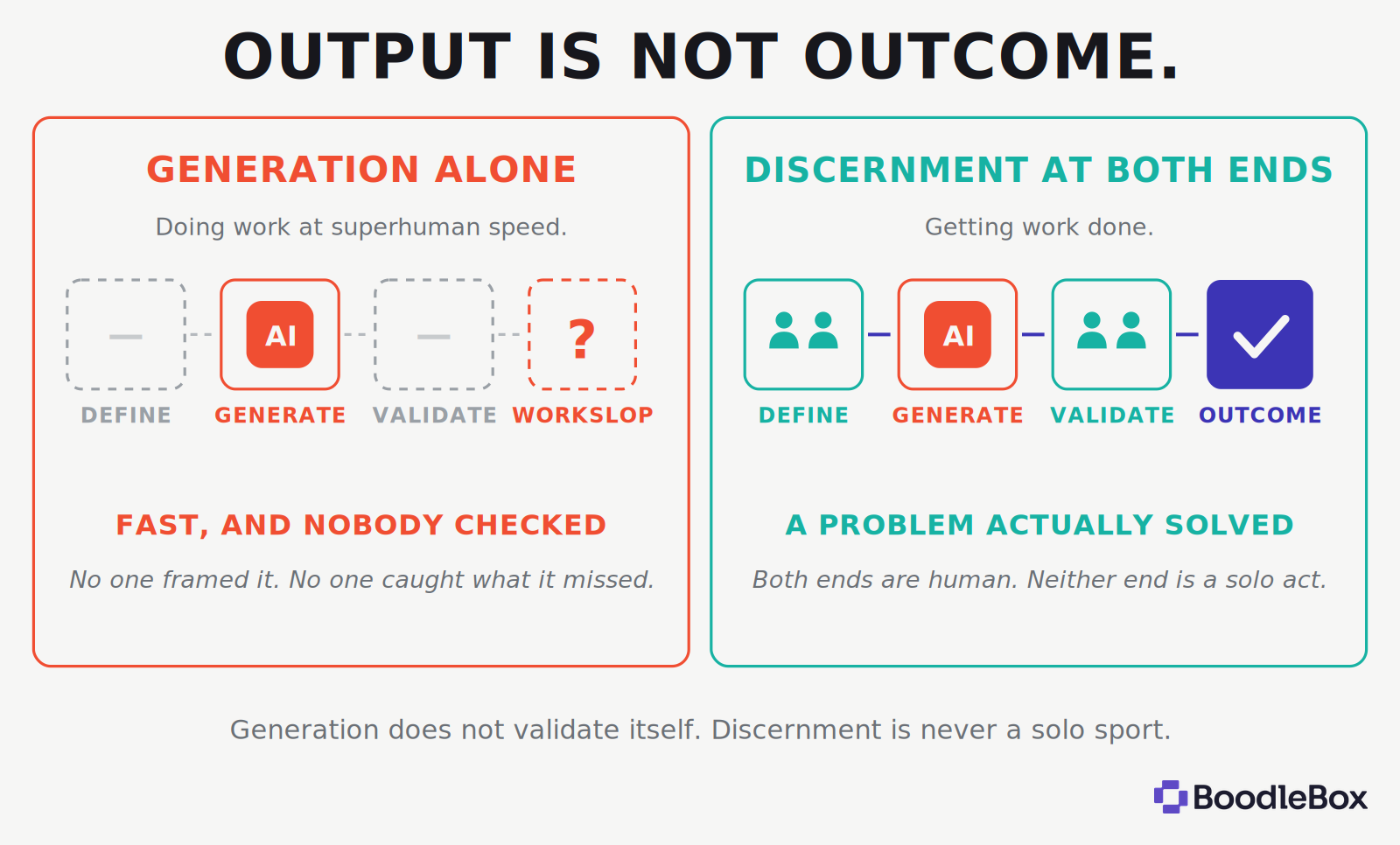
No matter how astonishing the output from cutting-edge models becomes, raw generation does not validate itself. Output is not outcome.4 When generation is nearly free, the bottleneck moves entirely to human discernment: knowing which problem is actually worth solving, asking what the model assumed, and catching what it missed.5
The industry has settled on a word for everything around a model that makes it useful: the harness. The model is the engine. The harness feeds it context, gives it tools, runs its loops, and decides what it remembers. It is why the same model can be mediocre in one product and remarkable in another, and it is increasingly where the real engineering happens.
Yes, it is a word borrowed from the stable, which is a little ironic coming from someone who keeps insisting AI is a car, not a faster horse. But a team harness is also the thing that lets several horses pull one load together. Hold onto that image.
Every serious harness built so far shares one assumption: one person at the wheel. Coding agents, research agents, the frontier chat apps — they are extraordinary harnesses, and every one of them is built around a single human's session. The context is theirs. The memory is theirs. When the session ends, so does the harness's understanding of the work.
That is the category we think is missing. A collaborative harness is the system around AI models that lets many people and many models work the same problem in shared, persistent context. It does four things a single-player harness does not.
If the road is the metaphor, the collaborative harness is the engineering under it.
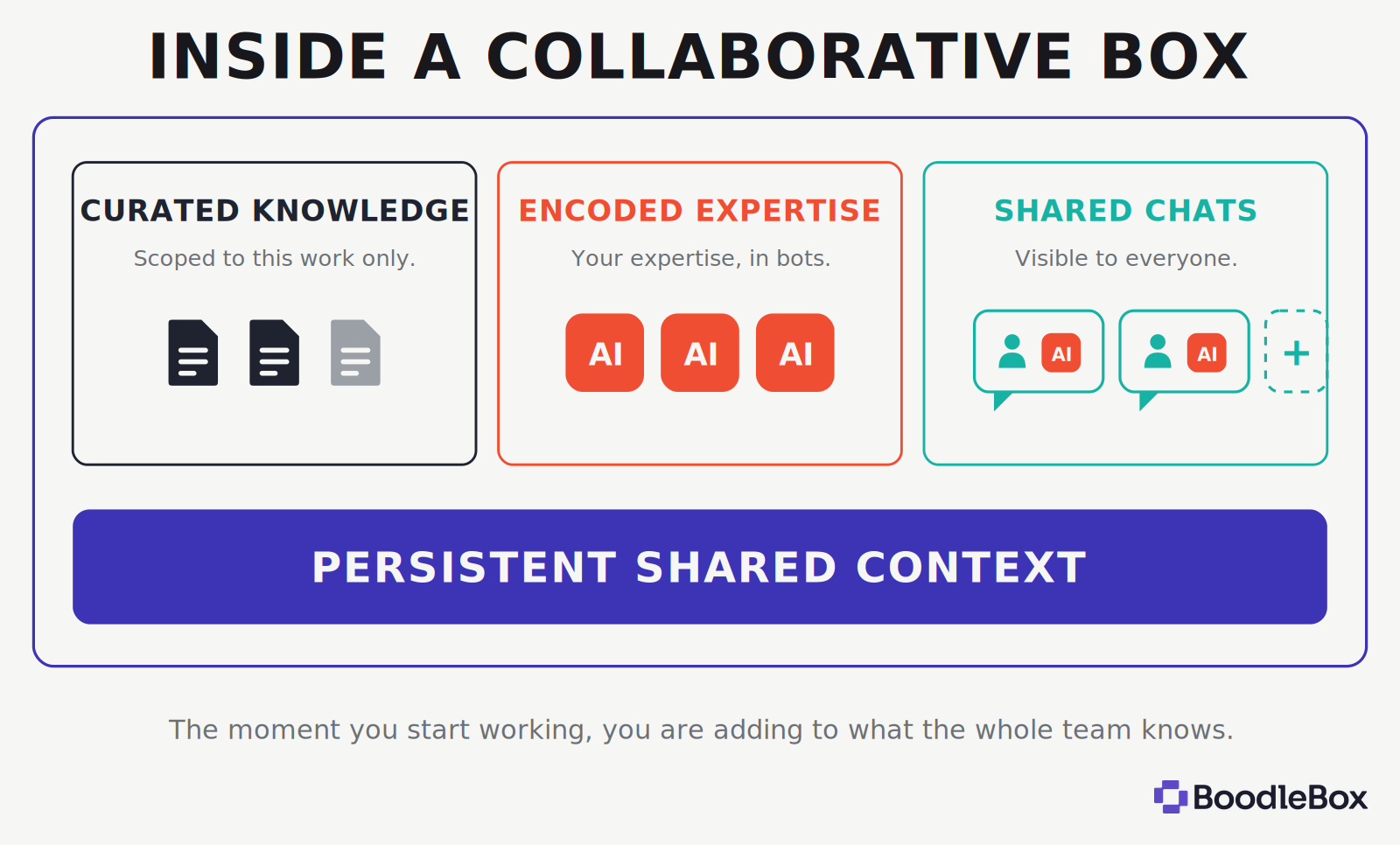
A Collaborative Box is BoodleBox's collaborative harness: a shared workspace for a team, a project, a class — any group doing real work together. Three things happen inside it.
That third one is what actually breaks the single-player pattern. You are not exporting your notes into a shared doc afterward and hoping somebody reads them. Context that has to be shared was never really shared — it was forwarded.6 In a Box, the moment you start working, you are already adding to what the team knows.
We did not invent this in a zoom meeting. We built it because we kept watching capable people jury-rig the same workaround on tools that were never designed for it.
Professors were the first to show us. They were creating shared folders and asking students to drop their AI conversations in — before a lecture, so the instructor could see where the class actually stood; after an assignment, so students could see how their classmates reasoned through the same problem. It worked. It was also a professor doing by hand, every week, what the platform should have been doing natively.
So we built it properly. It runs now as a purpose-built Collaborative Box, the AI Native Classroom, live with faculty and students across more than 150 colleges and universities, where hundreds of professors have built thousands of AI-native assignments.7 One told us it produced the best thesis statements she had seen from students in two years. What she was describing was not better output. It was a room where the thinking became visible — to her, and to the students, about each other.
The same instinct shows up in what people are willing to pay for. We keep meeting users who carry two, three, four frontier model subscriptions at once — not because they are indecisive, but because they are stacking by hand: draft in one, audit in another, attack the assumptions in a third, then reconcile the three by copying and pasting between tabs. The average American AI user now works with three general assistants, up from 2.2 a year earlier, and the heaviest payers are the ones spending the most.8 That is a widespread, expensive, entirely manual version of what BoodleBox does natively. People have already decided multi-model is worth the money. What nobody has given them is a place to do it where the models share the same context and the work survives the session.
Mark Lanier's trial team showed us the same pattern under real stakes. Fifty people in one shared, multi-model workspace — not one lawyer and a chatbot. They poured 42 years of case judgment into it until it reasoned in his voice, then ran each day's transcripts through several models overnight to find the soft spots. Of a hundred cross-examination questions it generated, he used six or seven. “A tool, not a replacement,” as he put it. Meta and Google had AI too. They generated. He collaborated. His clients won a $6 million verdict in the first social media addiction case to reach a jury.9
We have seen the same instinct in military staff sections, encoding tactical knowledge into individual chats and then sharing context between sections to assemble a common operational picture. We have seen it in companies, where sales encodes what works into one bot, support encodes hard cases into another, and somebody in ops spends their Friday stitching the outputs into a doc nobody opens.
Consumers, classroom, courtroom, operations center, go-to-market. Same story every time: real expertise, successfully encoded, and then trapped — because the tool holding it was never built to let it move. That is the gap Collab Boxes close.
Watch people solve genuinely hard problems with AI and you notice something. The best answer almost never arrives in response to one prompt from one person to one model. It shows up in the seams.
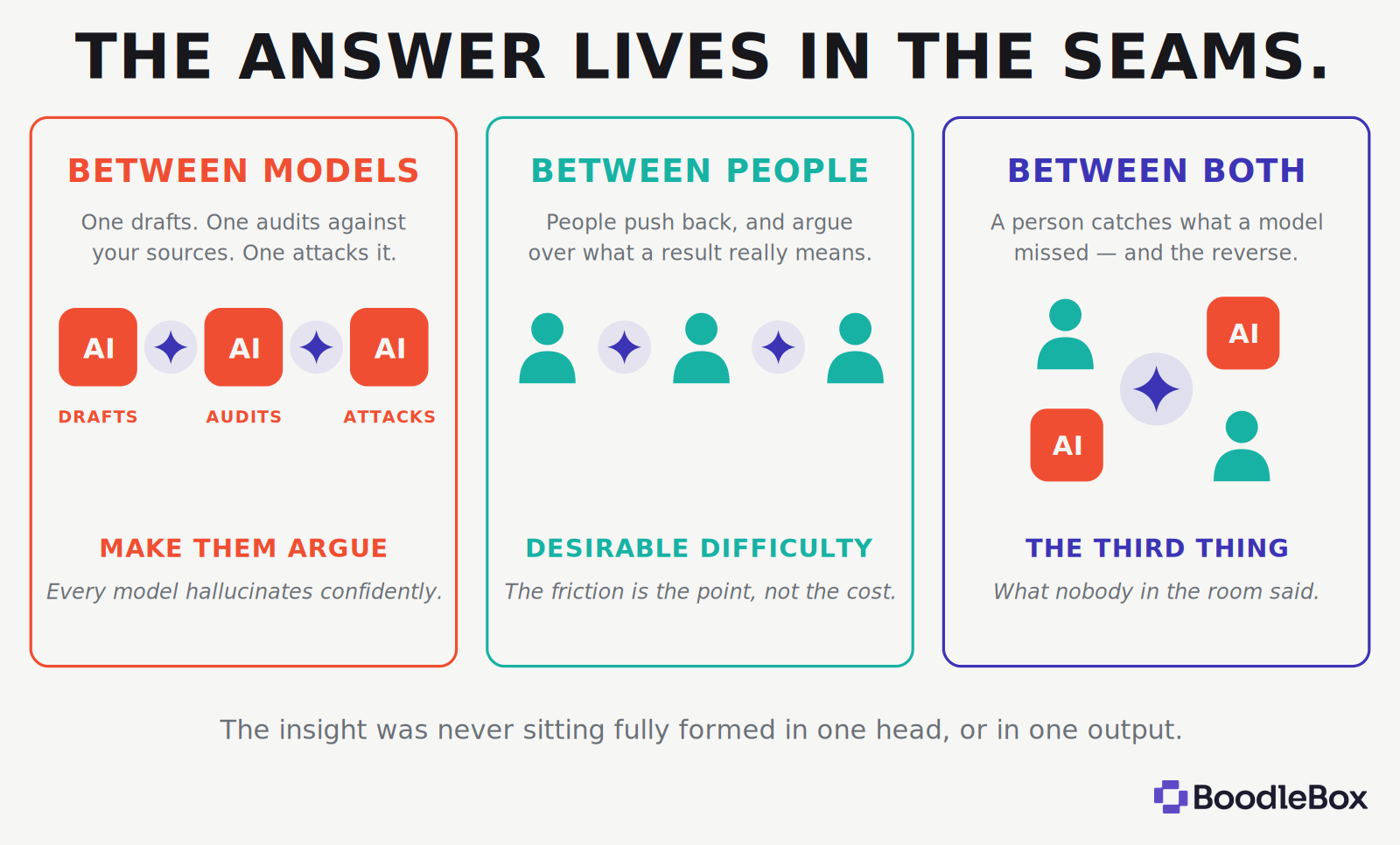
Between models. Every model has blind spots, and every model hallucinates with total confidence.10 Stacking bots inside a Box — one drafts, a second audits against your curated sources, a third attacks the assumptions — turns that from a risk into a method.11 You are not asking a model for the answer. You are making models argue in front of you, which is the oldest way humans have ever found the truth.
Between people. Put several humans in the same thread alongside those bots and you get something single-player tools are built to avoid: productive struggle, done together. People push back on assumptions, challenge what the AI just said, argue over what a result actually means. Learning science keeps finding that effort which feels inefficient in the moment is what builds durable understanding — Bjork calls it desirable difficulty, and Kapur found that groups who wrestle with a problem together before getting the answer outperform those simply handed it.12 Single-player tools are engineered to remove exactly that friction. That is their selling point, and it is their deepest flaw.
Between people and models, at the same time. This is the part that has surprised me most.13 A person catches what a model missed. A model catches what the room agreed on too quickly. Somebody reads both and sees the third thing nobody said.
The insight was never sitting fully formed in one head or one output. It emerges in the space between models, the space between people, and increasingly in the space where several people and several models work the same problem at once. That space is what a Collab Box is for. Everything else we build is scaffolding around it.
A new associate joins a trial team three weeks out. Anywhere else, that is three weeks of transcripts and catch-up briefings from colleagues who do not have three weeks. In a Collab Box, she opens it and everything the team has already worked through is there — every deposition analyzed, every theory tested, every dead end already marked as a dead end. Useful by lunch instead of by week three.14
Sixty students work a case study over two weeks, each at their own pace, each catching something different. Anywhere else, the professor gets sixty disconnected transcripts, if she gets anything. In a Collab Box, she asks what the class collectively understood and where it collectively got stuck — and gets a real answer, because all sixty conversations were in the same pool the entire time.15
Two people work a deal in parallel — one buried in contract redlines, one buried in diligence, barely talking for a week. Anywhere else, they sync on Friday and discover they each missed what the other found on Tuesday. In a Collab Box, the contract bot already knows what diligence turned up. By the time they sit down, they are not catching each other up. They are already aligned.
None of that is a faster chatbot. It is a team that stops forgetting what it already knows.
Slack, Teams, and Notion were built to move messages and documents.16 AI got added on top, and it is genuinely useful — it searches your files, summarizes a channel, answers a question about a doc. What it cannot do is treat everything happening across a team as one continuous, compounding body of understanding, because the core object of those platforms was always the message or the file. Never the context. AI sits on that architecture. It does not replace it.
The frontier chat apps and coding agents have the opposite limitation. They are the best single-player harnesses ever built, superb at one person going deep with one model on one thread. Even with shared projects bolted on, the default unit is still a single person's conversation. Somebody has to decide to create a shared space, add people, and push their context outward. The system doesn't natively do it on its own.
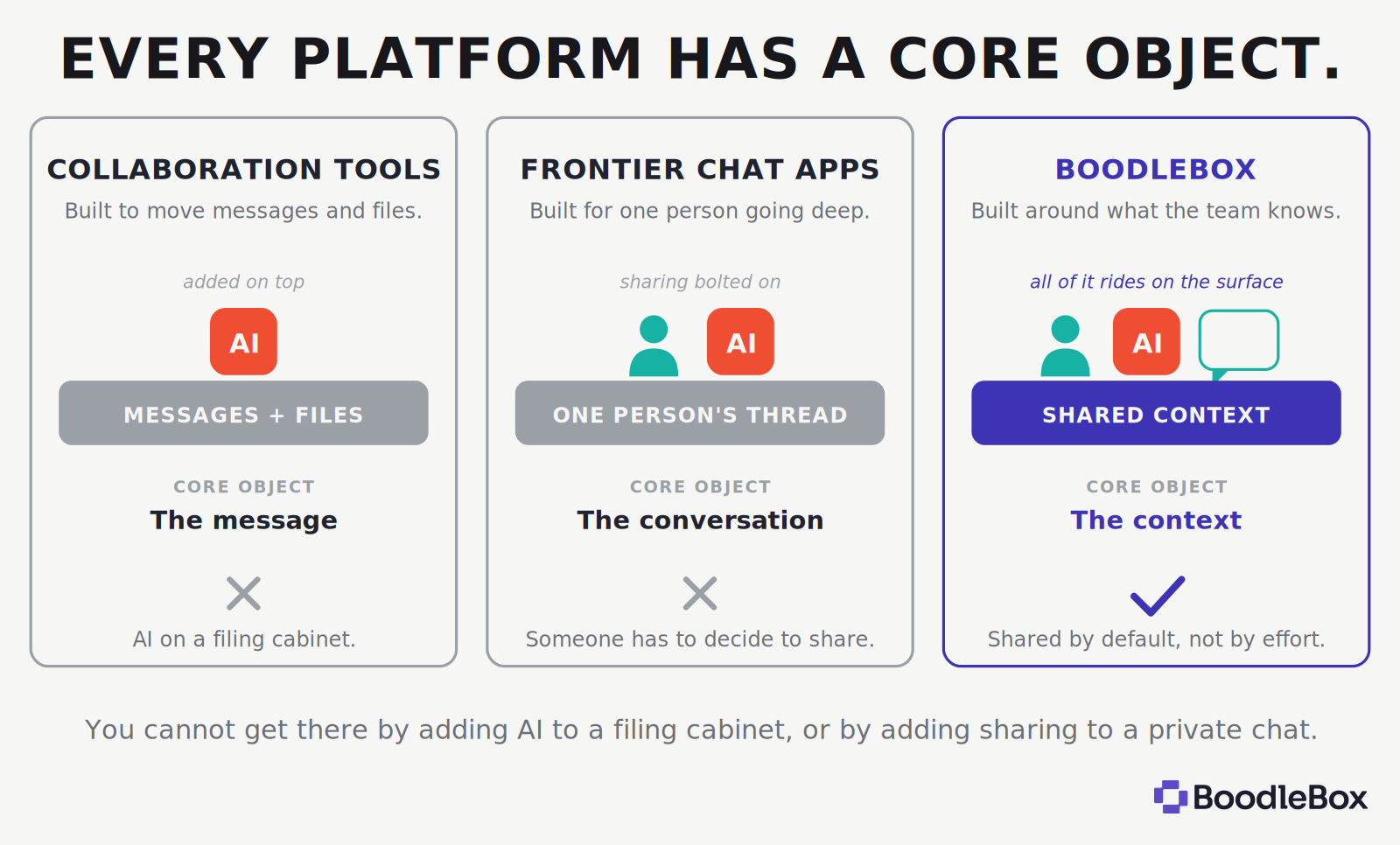
Neither was built around the question we actually care about: what does this entire team, working its own expertise against its own curated knowledge, know right now — without anyone having to go collect it?
You cannot answer that by adding AI to a filing cabinet, and you cannot answer it by adding sharing to a private chat. Shared context has to be the default the whole system runs on. That was our architectural bet on day one.
Generation gets faster, cheaper, and better every month. That race is not ours to win, and I am not worried about it. The hard part of the work is where it has been since AI inverted it: at the two ends. Defining the right problem. Validating the answer.
Here is what most of this industry keeps missing. Neither of those is a solo act. You frame a problem better when someone is arguing with you about it. You validate an answer better when someone is willing to tell you that you are wrong. Discernment is not something a person does alone in a chat window. It is something people do best together, and it always has been.
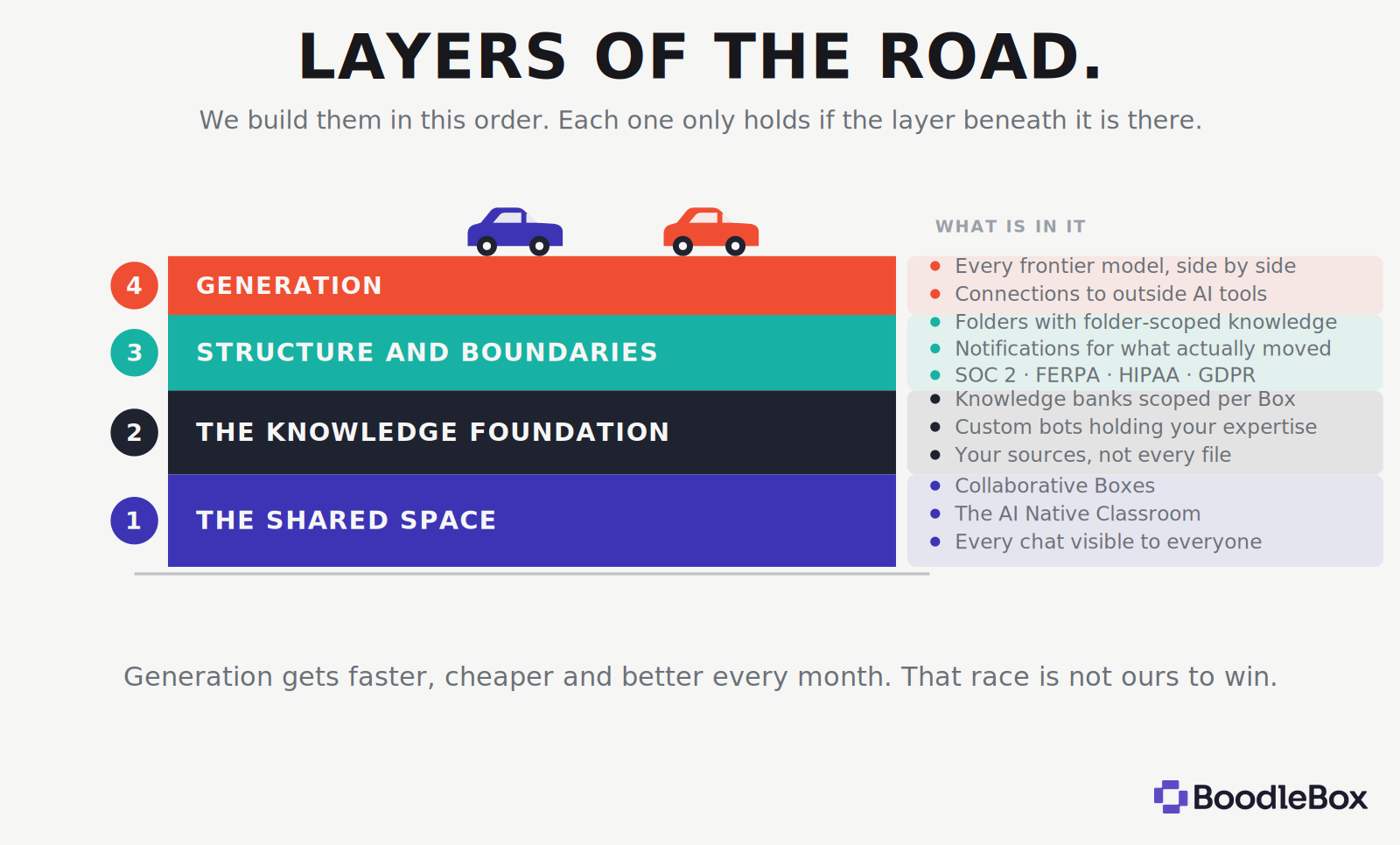
So that is what we build first, and in this order. The shared space, so a team can think in the same place. The knowledge foundation, so that thinking has something solid under it. The structure and the boundaries, so it holds up when the work is real and the stakes are high. Only then the layers that ride on top, including the ability to connect and leverage other AI generation tools. That stack, in that order, is what a collaborative harness is.
We are not trying to help individuals go faster by themselves. We are building the infrastructure that helps teams go further together — sharpening their judgment, compounding what they learn, and reaching destinations no single driver could reach alone.
That is the road we are building. It has more than one lane because the work never had just one driver or one car.
It is the road your team deserves.
More soon.
— France
Bring your team, your knowledge, and every leading model into one shared workspace.
Get a demoEvery entry below follows the same structure: the workflow as it runs today, the handoff where the thinking dies, and what changes when the context is shared. The fix has the same shape every time — several people and several models working one problem in one space that persists. The order matters: the reasoning is there the next time because the work was done together the first time, not because someone filed it afterward. Three of these — the trial cycle, the course redesign, the staff running estimate — come from work we have done. The rest apply the same pattern where we have seen the problem clearly and have not yet built the answer.
Software — incident response. Today: five engineers at 2 a.m. reconstructing a system's behavior from logs and one person's memory of a config change. The postmortem records the timeline, not the reasoning, so the next incident on an adjacent service starts from zero. In a Box: all five work the same thread against the architecture and every prior incident, with three models running competing hypotheses — one on the logs, one arguing it is the config change, one checking whether the last three incidents share a signature. The picture assembles once instead of in five heads, and the postmortem is a byproduct rather than a second act of recall.
Customer support — the escalation path. Today: tier-1 escalates with a summary, tier-2 escalates again with a different one, engineering resolves it in a ticket comment nobody upstream reads. The same issue escalates four more times that month. In a Box: all three tiers work the same thread, with a triage bot drawing on real resolution history and a second model arguing the likelier root cause. Tier-1 watches the diagnosis form instead of receiving a verdict. The macro library documents answers; a Box documents why, because why was said out loud in front of everyone.
Litigation — the overnight trial cycle. Today: the transcript lands at 7 p.m., three people mine it separately, and at 10 p.m. someone stitches four documents into one memo for the lead lawyer's 5 a.m. read. Every night, from scratch. In a Box: impeachment, expert-contradiction, and jury-reaction bots run on three different models against the whole case file, and each associate sees the others' chats as they happen. The 10 p.m. stitching job disappears. It was never the work.
In-house legal — the playbook redline. Today: a lawyer redlines an MSA from memory and a five-year-old position document. Eleven months later a colleague concedes the opposite point on the same clause. In a Box: the lawyer, the GC, a playbook bot built from what you actually negotiated, and a second model playing the counterparty all work the clause in one place. The compromise and the reason for it are made in the same breath, so the next lawyer inherits an argument rather than a redline.
Professional services — the audit engagement. Today: the partner asks a question that was answered three weeks ago inside someone else's workpaper. The engagement file records conclusions; the judgment behind them leaves with the senior. Next year half the team is new. In a Box: prior-year rationale and this year's fieldwork are one context, a bot tests each judgment against the firm's own precedent, and the review note becomes a conversation instead of a round trip.
Financial services — the investment committee. Today: three weeks of thesis, forty minutes of debate, two lines of minutes. Two years later nobody can reconstruct why the committee passed. In a Box: the analyst, the colleague writing the bear case, a devil's-advocate bot, and a second model auditing the numbers against your own research library all argue in the open. The committee reads the argument instead of receiving the conclusion.
Wealth management — the annual review. Today: the advisor knows the second marriage changed the beneficiary logic, the planner knows the liquidity event is eighteen months out, the specialist knows the concentrated position is a tax problem — and they reconcile it in a twenty-minute huddle in the lobby. In a Box: the household is the Box, and the three of them build the recommendation in the open with a suitability bot and a tax-drag bot in the thread. The huddle stops being where the thinking happens, and the reasoning transfers with the account when the advisor retires.
Insurance — the complex claim. Today: an adjuster, a medical reviewer, and an SIU investigator work the same file in three systems and trade summaries. The senior adjuster's instinct — this one smells wrong, and here is why — never leaves her head. In a Box: the three of them work the file in one place alongside a bot that surfaces near-identical prior claims and a second model attacking their read, and her instinct becomes a bot the unit works with instead of a person the unit queues for.
Healthcare — the quality improvement cycle. Today: a readmissions group meets monthly, tries an intervention, and why the last three failed lives with whoever was in the room. In a Box: clinicians, nursing leadership, and analytics work the intervention between meetings, with the data and every prior cycle in reach, one model proposing the change and another challenging whether the last result can be attributed to it at all. The group stops re-testing what it already ruled out, and the record of why writes itself. Healthcare is the largest vertical AI market by spend, which makes this the most expensive coordination gap on the list.
Life sciences — the agency information request. Today: a regulator asks about a justification written eighteen months ago by someone who has left. Three teams spend two weeks reconstructing why the paragraph says what it says — a best guess dressed as a record. In a Box: regulatory affairs, the study team, and biostatistics argued it out there in the first place, one model drafting against the guidance and another playing the reviewer, so the rationale sits beside the submission. The question is a lookup, not an excavation.
Higher education — the multi-section course. Today: six faculty teach the same course, each redesigns their own assignments, and the one who cracked AI-resistant assessment mentions it in the hallway. In a Box: the course is the Box — six faculty and their student-facing bots working in one place, so a redesign happens in view of the other five instead of in parallel with them. The chair can ask what the whole cohort is stuck on, a question that currently has no answerable form.
Defense — the staff running estimate. Today: S2, S3, and S4 each build their piece, and a battle captain hand-carries context between sections to assemble a picture that is stale before the brief ends. In a Box: all three sections work one continuous context, each running its own bots against its own data while seeing what the others are finding. The running estimate is a live object, not a meeting output, and what do we collectively know right now has an answer between syncs.
State and local government — the rulemaking comment cycle. Today: four thousand public comments, a handful of analysts, six months, and a response document that records dispositions without rationale. Why one objection was accommodated and a near-identical one was not lives in an unrecorded meeting. In a Box: the analysts work the corpus together alongside a clustering bot and a legal-sufficiency bot, so the argument over each disposition happens in the record rather than beside it. When the rule is challenged, the administrative record is a record of thinking.
Manufacturing — the corrective action. Today: a cross-functional team runs 5-Why on a line-3 defect, and the 8D report captures the conclusion but not the hypotheses ruled out. Eighteen months later a new team runs the same dead ends. In a Box: quality, maintenance, and process engineering work one thread, with a model ranking causes against the maintenance history and a second arguing for the ones they just dismissed. Every ruled-out cause and every operator's observation about humidity and that machine is recorded as it is said, so the second investigation starts where the first ended.
K–12 — the student intervention team. Today: four adults agree on an intervention and log it in a compliance form. What was tried last year — and why it worked for two weeks and then stopped — leaves with whichever teacher was in the room. Turnover erases it annually. In a Box: the counselor, the teacher, and the coordinator work the plan between meetings, with one bot surfacing what was tried before and another questioning whether the improvement can be attributed to it. The fourth attempt builds on the first three even when three of the four adults are new.
Philanthropy — major gift cultivation. Today: the CRM records the visit, the gift, the proposal — and none of the why. Why the ask was two million and not five. Why the named scholarship is right and the building is wrong. Why last year was the wrong year. The gift officer leaves inside two years; the file survives and the relationship does not. In a Box: a case-for-support bot drafts against what this donor actually said, a second bot argues the ask is mistimed, and the successor inherits a relationship instead of a contact history.
Faith-based organizations — congregational life. Today: sermon arcs, small-group curricula, the reasoning behind a hard governance vote, the history of a capital campaign — all held by whoever was there, and one staff transition erases a decade. In a Box: staff and lay leaders plan there rather than report there, with bots that hold the congregation's own history and the denomination's polity in the room. The institutional work accumulates; pastoral confidences stay where they belong, in the relationship. Denominations have the sharper version — the same polity question answered in forty congregations, forty separate times.
France Hoang is the Founder and CEO of BoodleBox, a Collaborative AI platform selected by more than 150 colleges and universities and 130 companies to bridge the gap between education and the workforce. Evacuated by the U.S. Military from Vietnam in 1975, France's journey — from refugee to West Point graduate to White House staffer — reflects the conviction at the heart of BoodleBox: that education, service, and collaboration unlock human potential at every level.
With over 25 years of experience spanning national security, law, technology, and entrepreneurship, France has served as Associate White House Counsel and Special Assistant to the President, deployed as the Executive Officer of a U.S. Army Special Forces Company in Afghanistan, and been on the founding teams of companies generating over $600 million in combined sales. BoodleBox now serves more than 120,000 users and is backed by a partnership with Microsoft Elevate.
France's work centers on AI readiness: equipping students and professionals with the skills to collaborate effectively with AI while sharpening the critical thinking, creativity, and ethical judgment that define human excellence. A frequent speaker on AI literacy and the future of learning and work, France is based in Colorado.
Learn more about the ins and outs of the BoodleBox workspace from our team of experts.
Schedule a meetingLooking for more information?