On March 25, 2026, Mark Lanier’s trial team won the first social media addiction case to reach a jury: a $6 million verdict against Meta and YouTube. Lanier later told Business Insider that AI let him get “30 hours of work done” in the 10 hours a day he had outside court.

His team did that work in BoodleBox, which Lanier called “Disney World compared to a swing set in the backyard.” Here are five things any trial team can take from how they used it.

Lanier’s lawyers worked with the AI in a single shared workspace, not in separate chatbot accounts. After court each day, the team met in the war room and split up the night’s tasks, such as pulling the five most critical documents on a point.
With the work in one place, nobody has to re-upload the record or start from a blank chat. Lanier reviewed what came back before it reached the courtroom.

Lanier had BoodleBox build him a bespoke AI that combines Gemini, Claude, ChatGPT and other models, and he used it in about 30 different ways on the case, he told the Guardian. Each day’s trial transcript went to different models for evaluation.
The team even turned Google’s own AI against Google. YouTube argued it was a streaming platform, not social media, so they asked Gemini. Gemini said YouTube is social media.
When the models agree, that is a sign to move on. When they split, a lawyer knows where to look closer.

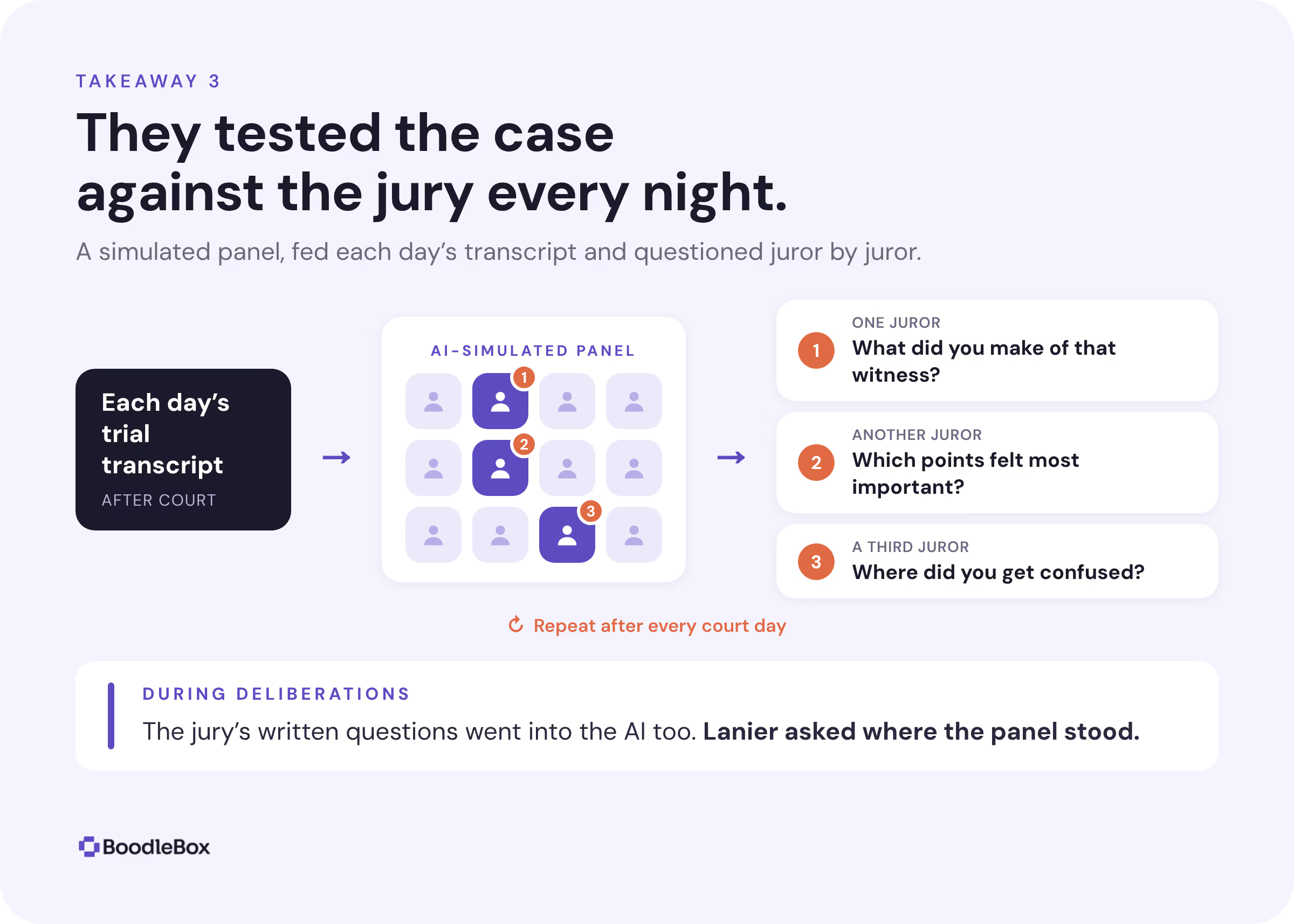
Lanier kept a panel of AI-simulated jurors. At the end of each day in court, he fed it the transcript and questioned it juror by juror: what one juror made of a witness, which points another found important, where a third got confused.
They kept going after closing arguments. During deliberations, Lanier fed the jury’s notes to the AI and asked where the panel stood.
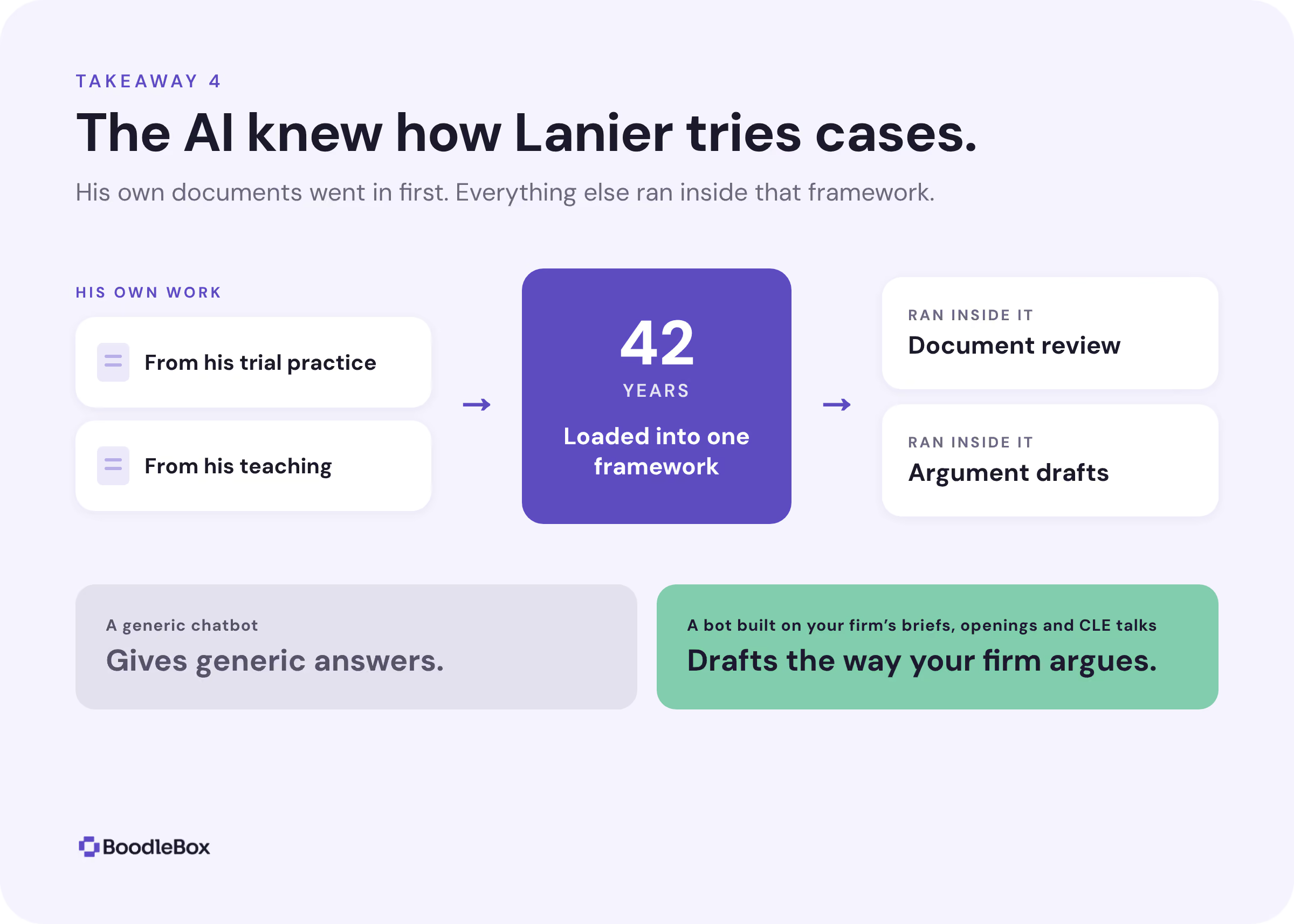
Lanier loaded his own documents into the platform, covering 42 years of practice and teaching, as he described on the Legal Speak podcast. Document review and argument drafts then ran inside that framework.
A generic chatbot gives generic answers. A bot built on your firm’s briefs, openings and CLE talks drafts the way your firm argues.
Lanier does not hand AI the legal research and brief writing, the shortcut that has landed other lawyers in trouble. During trial he caught the AI citing something from the record that he knew was wrong.
His rule is that AI never replaces the lawyer: “you look at it as an accelerant of what you do.”
These habits are not limited to a firm of Lanier’s size. A shared workspace, several models, bots built on your own work and a lawyer checking every output are available to any trial team.
Confidential AI for case preparation and research, with every leading model in one workspace.
Explore BoodleBox for legalLearn more about the ins and outs of the BoodleBox workspace from our team of experts.
Schedule a meetingLooking for more information?