← Back to Blog

From hype to habit: How a trial attorney learned to use AI in trial prep

From hype to habit: how a trial attorney learned to use AI in trial prep

Russ Brudner, Senior Trial Attorney at LPM Trial Law in Houston, uses BoodleBox to work through document-heavy preparation and to get better at prompting while he works.

Russ Brudner first saw a presentation on AI at Lanier Trial Academy 9.0. Before that, by his own account, he thought AI was all hype and meme-generation. Afterward he began using Anthropic’s Claude, and when he saw BoodleBox demonstrated at Lanier Trial Academy 10.0, he was blown away and hoped for a chance to use it.

Today he works in a dedicated BoodleBox workspace for trial preparation. This is how he got there and what he has learned.

A general-purpose AI subscription only goes so far.

Russ’s early AI use was limited to general questions. The gap he ran into was volume: a personal AI subscription could not take in the amount of documentation that trial work involves. He needed a workspace built to handle large document sets, and one that would help him learn as he went.

What changed: scale, model choice, Coach Mode, and custom bots.

Four things made BoodleBox different from the AI tools Russ had used before:

  • Volume. He could work with a large document set instead of a few pasted excerpts.
  • Model choice. He could pick the model that suited each task rather than being tied to one.
  • Coach Mode. The platform taught him to prompt better as he worked, flagging a good prompt or suggesting a better way to phrase the next one. “It’s just incredible, really,” Russ says. “The tool’s teaching you how to use the tool.”
  • Custom bots. Zach Kinzler, BoodleBox’s Head of AI Solutions, built a couple of starter bots for him. Once Russ saw the pattern, he built one himself.

He also learned something about pacing. Feeding in too much material and asking too much at once produced mistakes. Working in stages made the results reliable, and he describes becoming a better prompter along the way.

How he uses it in trial prep.

Russ uses BoodleBox across the reading-heavy parts of preparing for trial:
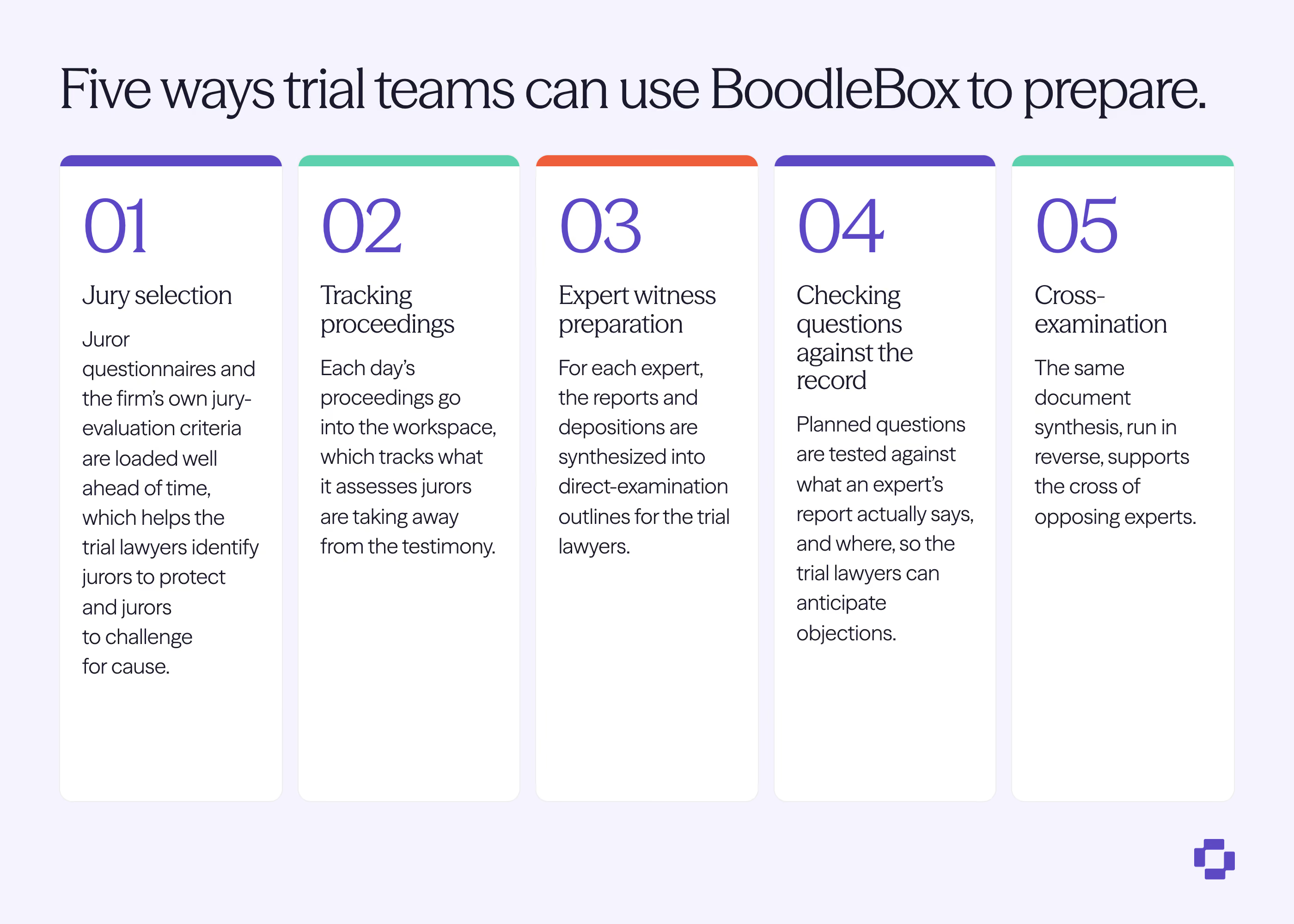
  • Jury selection. Juror questionnaires and the firm’s own jury-evaluation criteria are loaded well ahead of time, which helps the trial lawyers identify jurors to protect and jurors to challenge for cause.
  • Tracking proceedings. Each day’s proceedings go into the workspace, which tracks what it assesses jurors are taking away from the testimony.
  • Expert witness preparation. For each expert, the reports and depositions are synthesized into direct-examination outlines for the trial lawyers.
  • Checking questions against the record. Planned questions are tested against what an expert’s report actually says, and where, so the trial lawyers can anticipate objections.
  • Cross-examination. The same document synthesis, run in reverse, supports the cross of opposing experts.
Five ways a trial team can use BoodleBox to prepare

The volume of reading is what makes this work hard to do alone. “I don’t know how I could have done all that work without this tool,” Russ says.

A preparation partner, not a replacement for judgment.

Russ does not describe the platform as a substitute for legal judgment. He describes it as a capable partner for the reading and synthesis that take up preparation time. “[It’s] like having a team of very competent paralegals helping you get through the reading and preparation that goes into a trial,” he says.

Pull quote: “[It’s] like having a team of very competent paralegals helping you get through the reading and preparation that goes into a trial.” Russ Brudner, Senior Trial Attorney, LPM Trial Law

The value, as he sees it, is in the work he would rather not spend his time on. “It cuts through a lot of the part of practicing law that I hate … the busywork,” he says.
Pull quote: “It cuts through a lot of the part of practicing law that I hate ... the busywork.” Russ Brudner, Senior Trial Attorney, LPM Trial Law

Takeaways for other trial attorneys

  • Work in stages. Loading too much and asking too much at once is where mistakes crept in. Incremental prompting produced consistently better results.
  • Start with a couple of bots, then build your own. A short head start from the BoodleBox team was enough to get going, and building his own came quickly once he had seen the pattern.
  • Let Coach Mode do some of the training. In-the-moment prompting feedback did the work a formal onboarding process usually does.

What’s next: AI from the first day of a case.

Russ sees the larger opportunity earlier in a case’s life. He wants to run depositions through the workspace as they happen, identify what evidence is still missing, and make it easier for colleagues to get up to speed.

For a plaintiff-side firm, where early preparation carries a real opportunity cost, he sees BoodleBox making it more feasible to stay trial-ready throughout the life of a case, not just in the final stretch.

Based on a recorded interview with Russ Brudner. Quotes lightly edited for clarity and length.

See how BoodleBox works for legal teams.

Confidential AI for case preparation and research, with every leading model in one workspace.

Explore BoodleBox for legal

Request a demo →

Find out what's in it for you.

Learn more about the ins and outs of the BoodleBox workspace from our team of experts.

Schedule a meeting

Looking for more information?